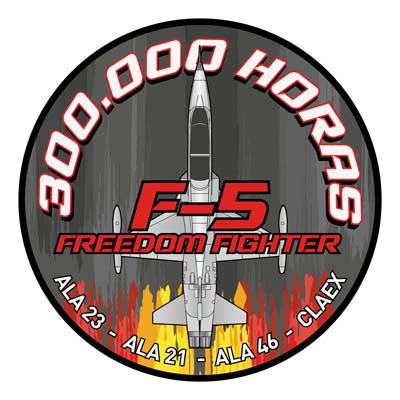
Una Leyenda en Vuelo
(A Legend in Flight)
Oil on Stretched Canvas 36” x 24”
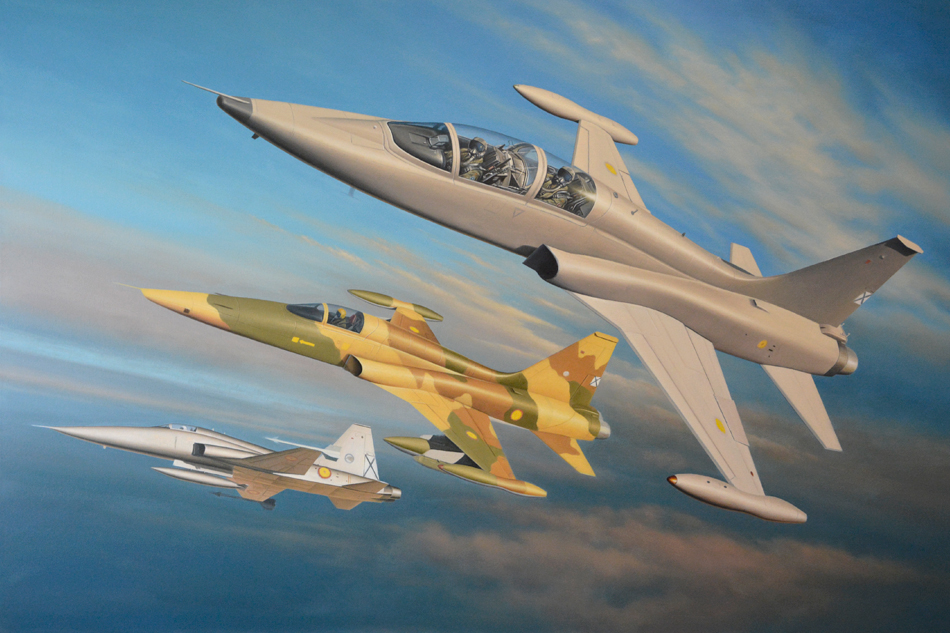
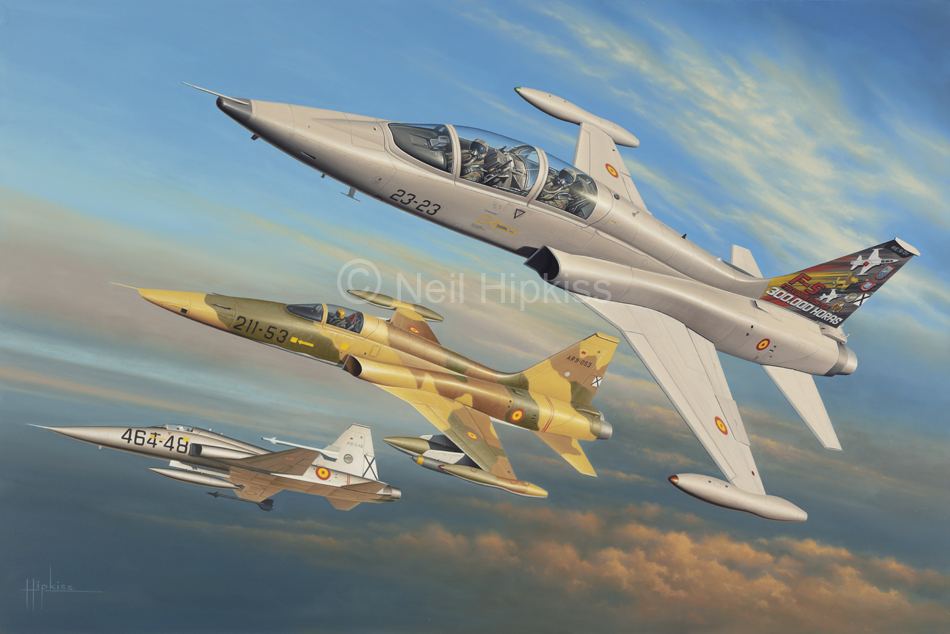
This painting was commissioned by Ala 23 of the Spanish Air & Space Force, to commemorate the SpASF achieving 300,000 flying hours with their F-5s.
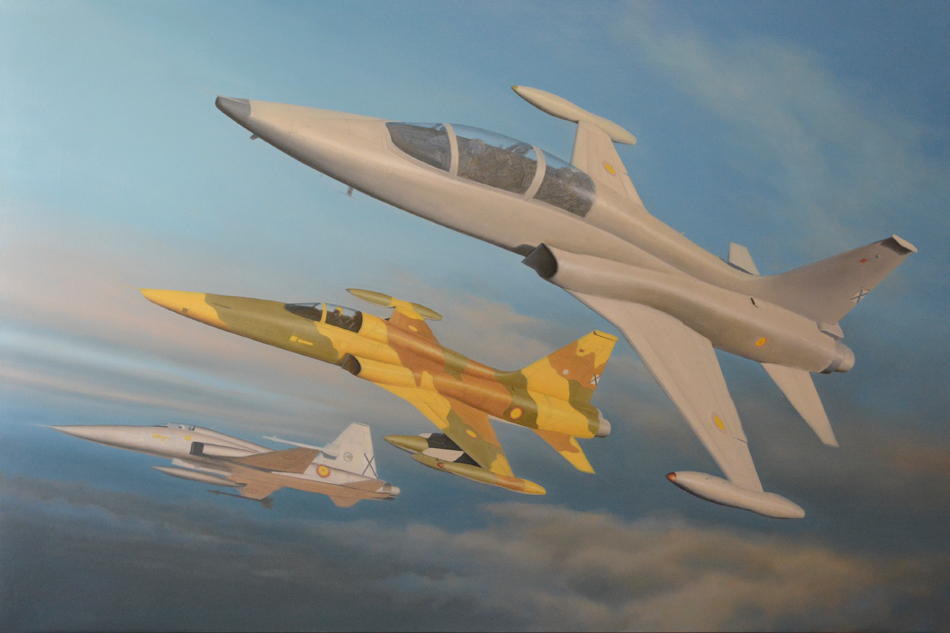
The brief was to include the three main variants of the F-5 flown by the three squadrons/wings with the greatest number of hours.
F-5M – Ala 23, Talavera La Real Airbase
RF-5A – 211 Sqn, Ala 21, Moron Airbase
F-5A – 464 Sqn, Ala 46, Gando Airbase
One of the F-5Ms operated by Ala 23 carried a special commemorative tail design, created to mark the 300,000 flying hours milestone. Given the significance of this aircraft and the event it represented, it was essential that the distinctive tail artwork was accurately represented within the painting.
The three aircraft were positioned in a side-on formation to ensure that the selected squadron codes and tail numbers were clearly visible. A degree of perspective was incorporated to convey a sense of movement and dynamism. As the aircraft were intended to be the principal focus of the painting, the background was deliberately kept simple. Subtle cloud formations were added to enhance the sense of depth and perspective, while also providing contrast that complemented the aircraft without distracting from them.
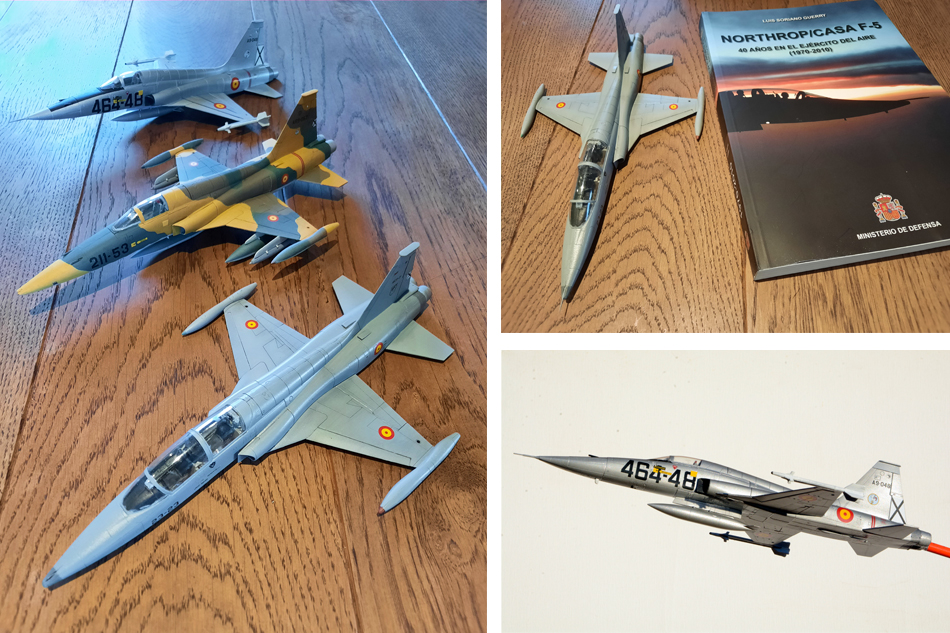
I began by constructing 1:48 scale models of the three F-5 variants, painting each aircraft in the markings of the selected squadrons to serve as accurate reference subjects.
Researching the aircraft during the model-building process helped provide a deeper understanding of their characteristics and details.
Once the models were completed, I arranged the aircraft in the attitude they would appear within the final composition and photographed them, ensuring a consistent direction of light across all three subjects.
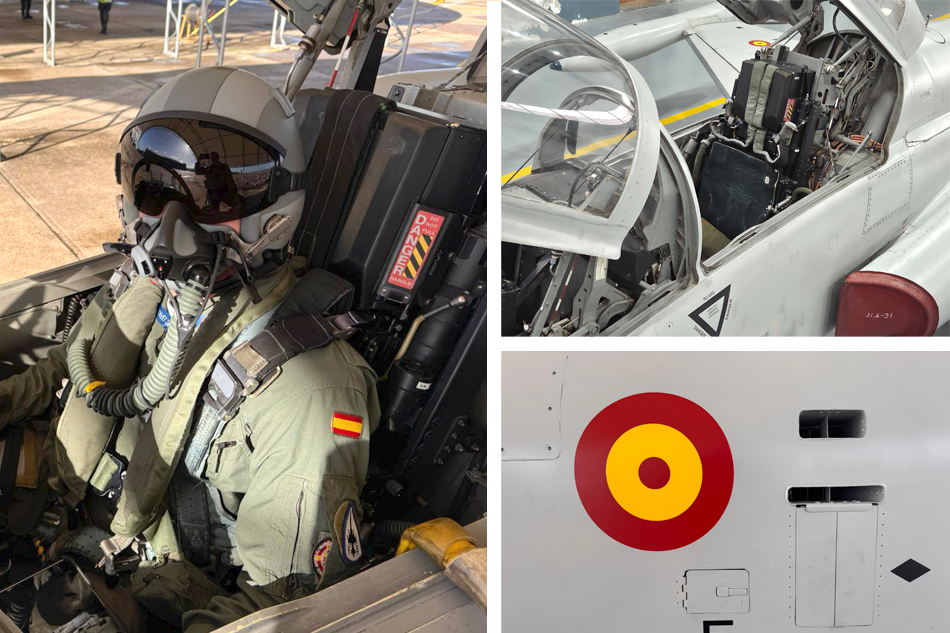
Whenever possible, I prefer to work using models, as they offer an excellent means of studying an aircraft's overall form and proportions. They also provide valuable insight into the way light interacts with the various surfaces, contours, and structures of the airframe under differing lighting conditions, contributing to a more accurate and convincing final painting.
Some models can however have limitations when it comes to showing finer details, and there is no substitute for viewing the actual aircraft. In this instance, the customer was extremely helpful, providing a wealth of information and reference photographs. Their contribution was invaluable in ensuring the technical and historical details were represented accurately.
The cockpit area of the F-5M occupies a prominent position within the composition. Having access to detailed photographs of this section of the aircraft, especially those showing a pilot seated in the cockpit, proved extremely valuable in capturing both the scale and authenticity of the subject.
My canvases are custom-made to order in any size, using premium-grade fine canvas stretched over hardwood stretcher bars. The hardwood construction provides maximum stability, which is essential when investing hundreds of hours in a painting. For this particular painting, the canvas was made to 36" × 24", providing ample space to capture a high level of detail across all three aircraft.
I gradually build a painting through the application of several thin layers of oil paint. Because oil paints are naturally translucent to a certain degree, each successive layer adds depth, strength, and definition to the image. This layering technique allows the painting to develop gradually, creating rich colour and subtle tonal transitions. I prefer this method to applying a single thick layer of paint, as it produces a smoother finish and allows for a much finer level of detail. The result is a painting that rewards close inspection, with intricate details that cannot be achieved through a more direct approach.
The composition was first designed and submitted for approval before the outline was carefully transferred to the canvas. I prefer to plan a painting thoroughly at the outset and remain faithful to that vision, rather than making significant compositional changes as the work progresses.
Once the outline was complete, I applied the first layer of paint, a stage commonly known as "blocking in". This initial coat establishes the basic shapes, colours, and tonal values of the composition. As the painting will be built up through multiple layers, there is no need for extensive detail at this stage. Its purpose is simply to create a solid foundation upon which the subsequent layers can be developed.
I generally build a painting using three or four layers of paint, followed by a final detailing stage, with each successive layer adding greater depth and refinement.
At this point in the process, I begin applying oils that are much closer to the final colours, shades, and tones of the finished artwork. As the painting develops, the image becomes increasingly defined, making it easier to visualise the finished composition.
By this stage, the overall design has already been established, allowing the final layers to be applied without the need for any significant changes to the composition.
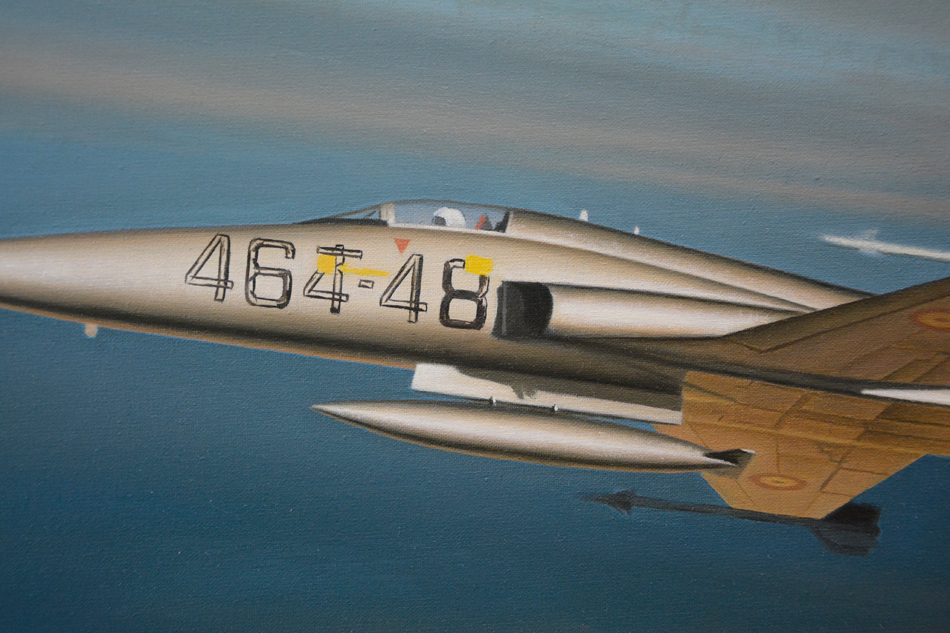
The final stage of the painting process involves adding all of the finishing touches, including panel lines, highlights, stencilling, and the smaller details that bring the aircraft to life.
Accuracy is important in every painting I undertake, but it becomes especially critical when the artwork will be viewed by the pilots and ground crew who have flown, maintained, and worked alongside these aircraft.
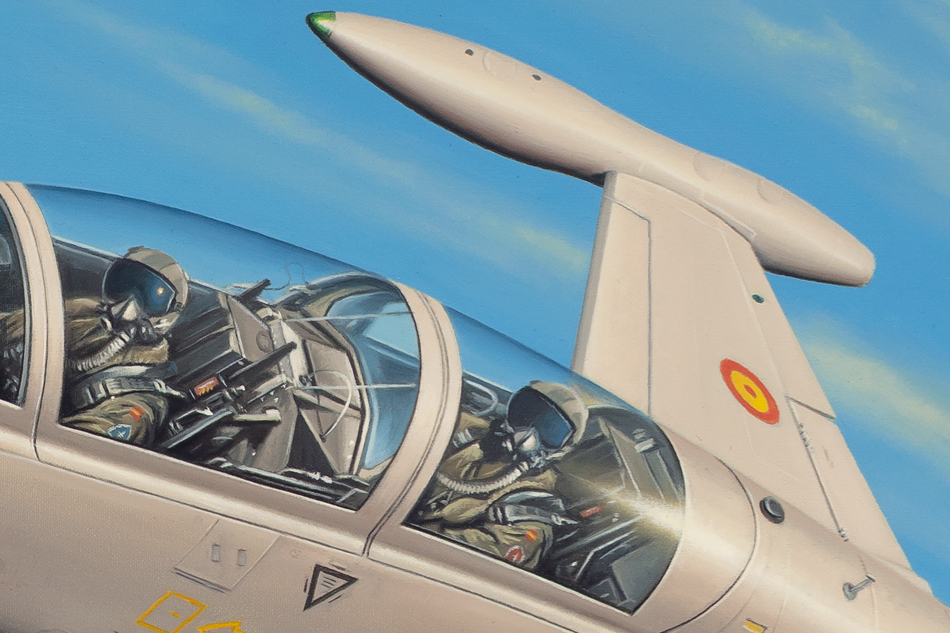
Careful attention to the smallest details helps ensure that the painting not only accurately depicts the aircraft itself, but also faithfully represents the people, history, and squadron identity.
F-5 pilots are awarded distinctive arm patches to mark significant milestones in their careers, such as accumulating 1,000 flying hours on the type. A closer inspection of the painting reveals that the pilot in the front seat wears a blue patch denoting 1,000 hours on the F-5, while the pilot in the rear seat wears a red patch signifying the achievement of 2,000 flying hours. These subtle details help to recognise the experience and dedication of the aircrew while adding an additional layer of authenticity to the artwork.
The level of weathering and ageing applied varies according to the subject and its operational condition. In this case, after consultation with the Wing Commander, the lead F-5M was depicted in a clean condition. The aircraft are regularly cleaned and repainted, so a heavily weathered finish would not have accurately reflected their appearance.
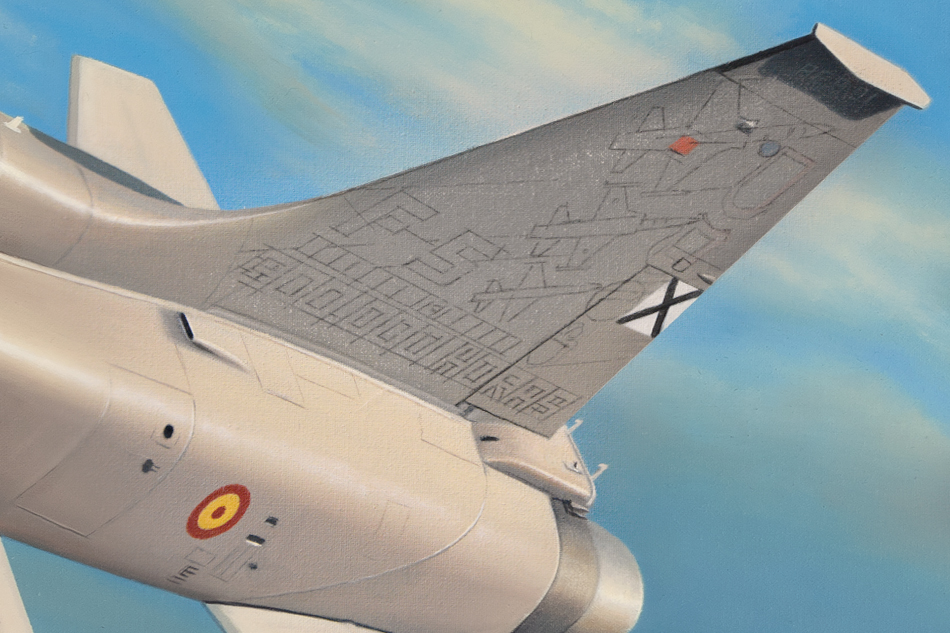
One of Ala 23's F-5Ms received a special commemorative tail design to mark the milestone of 300,000 flying hours. The design featured all three F-5 variants represented in the painting, together with their associated wing crests, creating a visual link between the aircraft's past and present service.
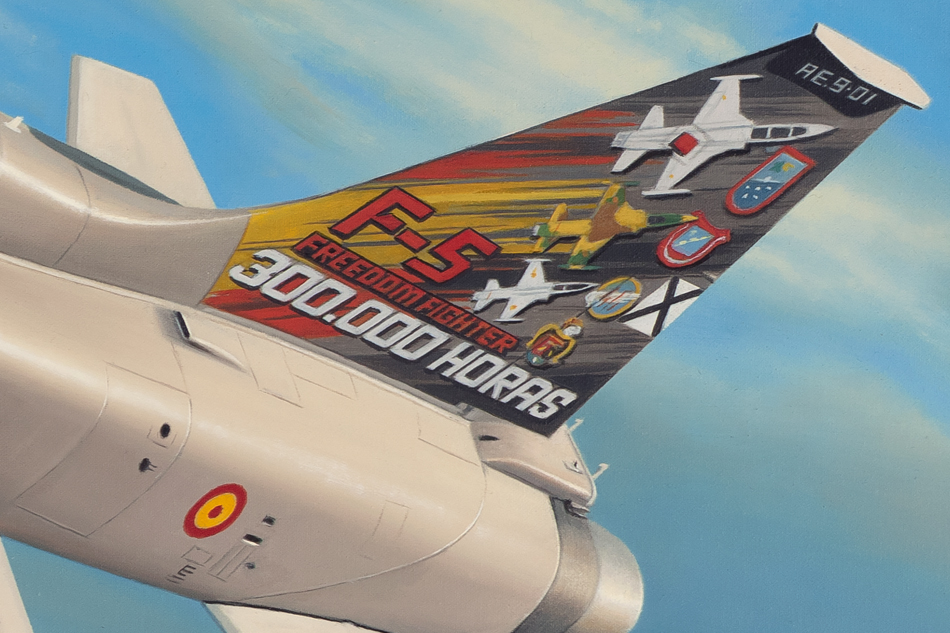
The tail design was developed independently at the same time as the painting and was only finalised towards the latter stages of the project. As a result, it became the final detail to be added to the artwork. More than just a decorative feature, the commemorative tail design became an essential element of the composition, bringing together the various themes of the painting and providing a fitting tribute to the achievement being celebrated.
The F-5M featured in the painting belongs to Ala 23, based at Talavera la Real Air Base. It is the most recent variant of the F-5 to serve with the Spanish Air Force used for advanced air combat and ground attack training. The aircraft selected for the painting, AE.9-01, holds a special place in Spanish aviation history. It was the first F-5 to enter service with the Spanish Air Force and, remarkably, remains operational 57 years later, carrying the fuselage number 23-23.
In reality, the commemorative tail design was applied to a different aircraft, AE.9-14. However, given the historical significance of AE.9-01, it was felt that this aircraft should be featured in the painting displaying the special tail artwork. While this represents a small artistic licence, it allowed the painting to combine the most historically significant aircraft in the fleet with the distinctive design created to celebrate the 300,000-hour milestone.
With the painting complete, the final stage of the process is preservation. In some cases, a retouching varnish is applied to restore the richness of colours that may have dulled slightly during the drying process, particularly the darker tones. However, this is not always necessary and depends on the characteristics of the finished painting.
The artwork must then be left to rest for several weeks, allowing the oil paint to continue hardening and stabilising. Once the surface is sufficiently cured, a final varnish can be applied. This protective coating enhances the depth and vibrancy of the colours, unifies the finish across the painting, and helps preserve the artwork for many years to come.
The original painting was officially unveiled during a special event held at the conclusion of a day of formal celebrations. The occasion brought together more than 250 F-5 pilots, past and present, in recognition of the aircraft's remarkable service and the milestone of 300,000 flying hours. It was a great privilege to have the painting unveiled in front of so many individuals who had flown, instructed on, and maintained the F-5.
This was a particularly enjoyable commission for a number of reasons. The F-5 has always been one of my favourite aircraft, and having the opportunity to paint three different variants in a single composition was a real pleasure. Equally, being commissioned to create a painting celebrating 300,000 flying hours of F-5 operations was a tremendous honour. It was a privilege to contribute, in a small way, to the commemoration of such a significant milestone in the aircraft's service history. Projects like this are especially rewarding, not only because of the aircraft themselves, but also because of the history, people, and achievements they represent. The opportunity to capture and preserve these achievements through art is one of the most satisfying aspects of my work.